The actual evidence
Does spray foam actually rot roof timbers?
It can, but not always, and where it was sprayed decides more than which type it is. HSE modelling dated February 2024 found low risk where open cell foam was installed to BS 5250:2021 with a ventilated gap behind it, and high risk in every scenario where foam went straight onto tiles.
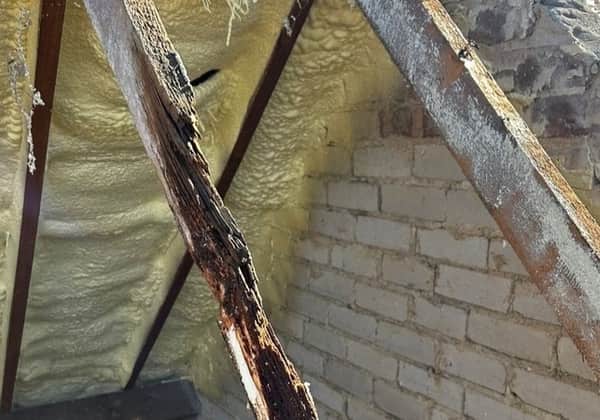
The mechanism is not mysterious. The House of Commons Library, summarising Property Care Association guidance, says that incorrectly installed foam can reduce air circulation and ventilation within a roof space, lead to dampness and condensation on the underside of a roof because it forms an air barrier and stops moisture escaping, and place timber-framed roofs at risk of decay.
What turns that from a warning into something you can act on is the modelling study the Health and Safety Executive published as the Building Safety Regulator, dated February 2024 and released in March that year. It simulated timber decay over five years across a range of real construction build-ups, and rated each one: high risk means more than 25% predicted decay in the outer layer of timber, medium is 1% to 25%, low is under 1%. It modelled two climates, one typical of London and a more severe one typical of Newcastle.
Predicted timber decay risk by what the foam was sprayed onto, from the Health and Safety Executive's February 2024 modelling report. AVCL means an air and vapour control layer on the warm side of the insulation.
| What the foam was applied to |
Foam type |
Milder climate |
Severe climate |
| Breathable underlay, no AVCL | Open cell | Low | Medium |
|---|
| Closed cell | Low | Medium |
| High resistance underlay, no AVCL | Open cell | High | High |
|---|
| Closed cell | Low | High |
| Straight onto tiles or slates | Open cell | High | High |
|---|
| Closed cell | High | High |
The highest risk assessed is when spray foam insulation is applied directly onto tiles or slates. This leads to high risks under all modelled scenarios.
That sentence is the Health and Safety Executive's, not ours. It is why this guide keeps telling you to look at what the foam is stuck to rather than which type it is. The same study also found that where the roof covering lets water in, or where there are small gaps between the foam and the rafters, the condensation risk goes up further, and that those risks are likely to be highest where closed cell foam was used.
The honest counterweight, which most pages leave out
Correctly installed foam is not automatically a disaster, and the same HSE study is the evidence for that too. It found risks are low where open cell foam is applied in line with the roof constructions set out in BS 5250:2021, which include a vapour control layer on the warm side and a ventilated space left between the insulation and the underlay.
Simon Storer, chief executive of the Insulation Manufacturers Association, put the industry's case to the BBC: the phrase spray foam "has created fear based on a lack of knowledge", and "insulating is a very good thing" but "as with any building work, it needs to be done correctly". On the evidence above, that is a fair summary. The trouble is that a lot of it was not done correctly, and you cannot tell which from the outside.
The trap in "just ventilate it more"
People suggest this constantly and it deserves a straight answer. The HSE modelling looked at it, and found that ventilating the loft void heavily enough to control the mould and condensation risk "would almost entirely undermine the thermal benefit of the installation such that the original purpose of insulating would be lost". In other words, you can ventilate the problem away, but then you have paid for insulation that no longer insulates.