Homeowner’s guide
Can’t you just do it off a ladder? Scaffolding, insurance and your liability.
Am I liable if a roofer is injured on my property?
It is a fair question, and it deserves a straight answer. Most of the difference between a cheap roofing quote and a proper one is not profit. It is scaffolding, insurance and time. This page explains why those things protect you, what UK law actually says about your own liability if a roofer is injured on your property, and what to ask before you hand anyone a deposit.
We do not sell scaffolding or safety equipment, so this is not a sales pitch. Homeowners ask us about it almost every week, so we wrote a clear and honest answer you can trust.
Before you pick a quote
The cheap quote does not remove the cost. It moves it to you.
Scaffolding, insurance and safe working are not padding on the bill. Strip them out to hit a lower price, and here is what you take on instead.
-
Someone badly hurt at your home
Falls from height are Britain’s biggest workplace killer, and skipping a proper working platform is how many of them happen.
-
A claim that lands on you
If an uninsured worker is injured here, you can become the one they claim against.
-
Damage no one pays for
A tool through your conservatory, or a neighbour’s car, with no insurer standing behind it.
-
A house sale that stalls
Uncertified roof work can freeze a future sale until you buy indemnity cover or drop your price.
-
A cowboy who vanishes
A big deposit up front, nothing in writing, gone the moment something goes wrong.
Hire right, and almost none of this lands on you
Choose a competent, insured roofer and let them get on with the job. UK law then keeps the risk on their side of the fence, not yours, and the rest of this page shows you how to tell a proper quote from a risky one in about ten minutes.
About this guide
The short version
Five things worth knowing before you choose a quote
- You are usually not liable. If you hire a competent, insured roofing contractor and let them get on with the job, English law protects you if one of their workers is hurt on your property.
- Choosing badly is the risk, not the roof. The thing that shifts legal and financial risk onto a homeowner is hiring someone incompetent or uninsured, telling them how to do the work, or hiding a hazard you know about.
- Scaffolding is a third party cost, not a markup. Your roofer pays a scaffolding firm for it. Under the Work at Height Regulations 2005 there is no minimum height below which the rules stop applying.
- Their insurance is your financial firewall. If an uninsured roofer damages your neighbour’s property or injures a passer by, the injured party looks for someone solvent to pursue. That can be you.
- Falls from height are still the biggest killer at work in Britain. 31 of the 126 workers killed in Great Britain in 2025/26 died falling from height (HSE, provisional). Roof work accounts for around a quarter of all construction deaths.
The rest of this page is the detail behind those five points, with the law, the cases and the numbers, so you can check any of it yourself. It applies to every kind of roofing work we do, from a full re-roof to a single repair.
Part one
Why should you care whether your roofer follows health and safety?
Because a roofer’s safety failures land on your property, your money and occasionally your legal position. A serious accident stops the job dead, turns your home into an investigation site, and if the contractor is uninsured, leaves an injured person looking for someone solvent to claim against. Safe working is not the roofer’s private admin. It is what keeps the risk on their side of the fence.
Most homeowners assume health and safety is something a builder deals with for his own benefit, a bit like his van insurance. It is not quite that simple. Roofing is one of the few trades that carries out genuinely dangerous work while standing on something you own, above a garden your children use and next to a road your neighbours walk down.
That creates four practical exposures for you:
- Money. Damage to your roof, your conservatory, your neighbour’s car or a parked vehicle. Someone has to pay for it. If the contractor has no public liability cover and no assets, a County Court judgment against them may be worth nothing.
- Time. A serious accident halts work immediately. The site becomes an HSE investigation. You are left with a stripped roof, a suspended job and the prospect of re-quoting with another firm.
- Your legal position. Narrow, but real. It turns on whether you chose competently and whether you controlled how the work was done. Both are covered in detail below.
- Living with it. The part nobody puts in a quote. If someone is badly hurt or killed at your house, that happened at your house.
Which is why “he was half the price” is worth interrogating rather than celebrating.
Part two
Can a roofer just use a ladder instead of scaffolding?
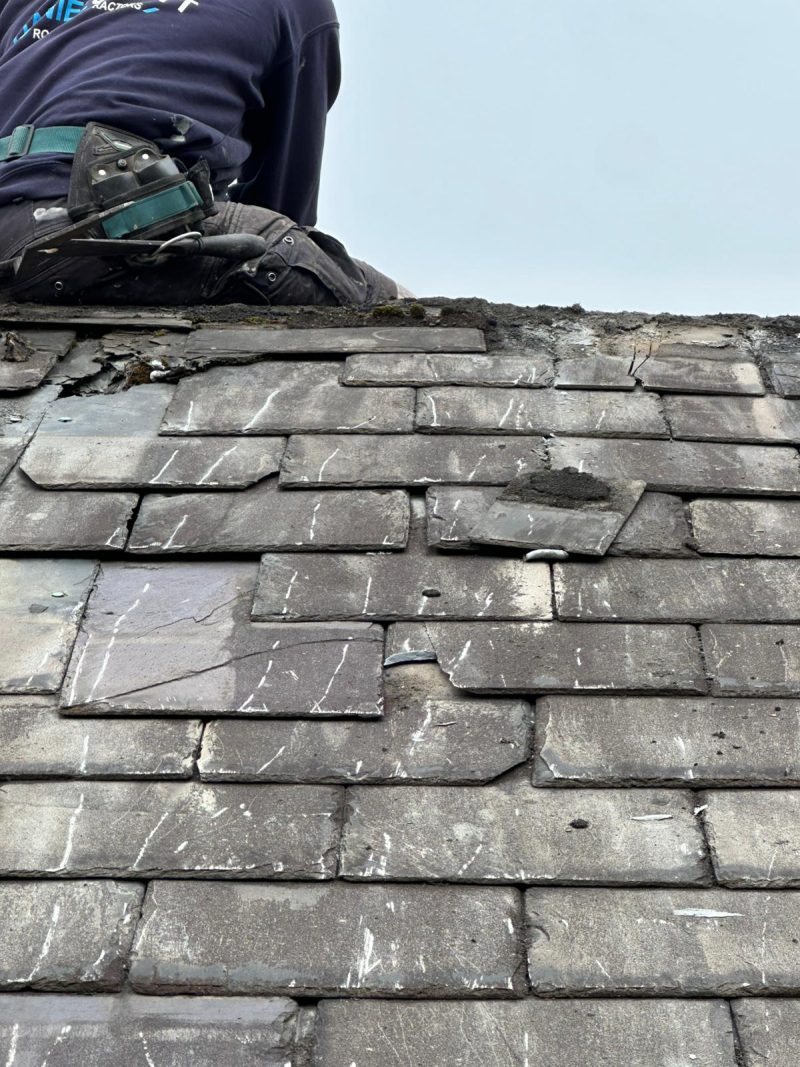
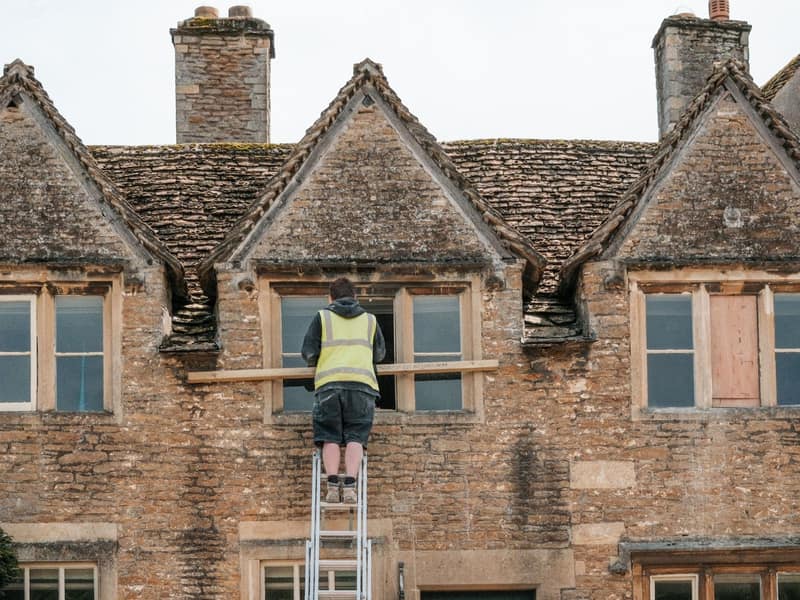
Sometimes, but only for low risk, short duration tasks, or to access a proper working platform. A quick inspection or a single slipped tile can be legitimate ladder work. A full re-roof, extended work at the roof edge, guttering and fascia runs or chimney work generally requires scaffolding or an equivalent platform. Doing that off a ladder is not the same job done cheaper. It is usually an unlawful method of work.
What the law actually says
Roof work in Great Britain is governed by the Work at Height Regulations 2005 and the HSE’s guidance HSG33, Health and safety in roof work (5th edition, 2020). Two features of those regulations surprise most homeowners.
First, there is no minimum height. The regulations apply anywhere a person could fall a distance liable to cause injury. A single storey extension counts. A garage roof counts. In one of the leading court cases on this subject, the fall was around one and a half metres and the injuries ended the man’s career.
Second, the law sets a hierarchy of controls that must be worked through in order, not picked from:
- Avoid working at height where the job allows it, for example surveying a roof from the ground with a camera pole or drone.
- Prevent falls using collective protection first, meaning scaffolding with guardrails, mid rails and toe boards, or a powered access platform, before personal protection such as harnesses.
- Minimise the distance and consequences of a fall where some risk remains, using nets, airbags or soft landing systems.
Ladders sit near the bottom of that hierarchy. Under Schedule 6 of the regulations a ladder may be used for work at height only where a risk assessment shows that more suitable equipment is not justified because the risk is low and the work is of short duration. That is a narrow permission, not a general licence.
Reasonable ladder work
Inspecting a roof. Clearing a gutter. Refixing one slipped tile. Getting safely up to a working platform that is already erected. Short, low risk, done and off.
Scaffold or platform territory
Full re-roofs and re-covers. Replacing multiple tiles or slates. Guttering, fascia and soffit runs. Chimney rebuilds and repointing. Leadwork and valley work. Anything involving sustained work at the roof edge, or carrying materials up and down.
If a quote covers work in this list and contains no scaffolding line, that is not a cheaper way of doing the same job. It is a different, riskier and probably unlawful method of work, and the saving comes out of somebody’s safety margin.
Why “half the price, no scaffolding” is a warning, not a bargain
Two real prosecutions make the point better than we can.
In February 2025, self employed roofer Daniel Hooper, trading as Hooper Roofing, was sentenced at Exeter Magistrates’ Court after his employee Iain Smith fell more than 25 feet while carrying old slates down a ladder fixed to a scaffold platform at a domestic property. Mr Smith suffered five broken vertebrae plus skull and rib fractures and spent five days in an induced coma. Hooper admitted breaching regulation 4(1) of the Work at Height Regulations 2005 and received a 16 week prison sentence suspended for 12 months, 150 hours of unpaid work and £10,875 in costs.
In April 2023, Patrick McCarthy, trading as All Care Home Improvements, was jailed for 14 months at Harrow Crown Court. His worker Andrei-Ionel Hutanu, 33, had been repairing a tiled pitched roof from a roofing ladder with no scaffolding in place. He fell around 16 feet onto a concrete alleyway and died a week later. McCarthy admitted breaching regulation 6(3) of the same regulations.
Neither man was prosecuted for being expensive.
Part three
Why does scaffolding cost what it costs?
Because it is a separate safety structure, hired from a separate company, erected and inspected by trained scaffolders. Your roofer buys it in and passes the cost on. Typical UK domestic scaffolding runs from a few hundred pounds for one elevation to a few thousand for a full wrap. If a scaffold sits on a public pavement it also needs a council licence under the Highways Act 1980.
| Scope | Typical range | Usually covers |
|---|---|---|
| One elevation, two storey semi | £490 to £870 | Erection, dismantle, transport, standard hire period |
| Front and rear access | £1,000 to £1,650 | As above, two elevations |
| Full wrap | £1,800 to £2,950 | All elevations, typical full re-roof setup |
| Priced per square metre | £15 to £25 per m² | Common alternative pricing method |
What you are actually paying for
Most quotes bundle erection, dismantling, transport and a standard hire period, commonly six to eight weeks. Only overruns caused by weather, slow snagging or multiple trades trigger weekly extension charges. Chimney scaffolds and birdcage scaffolds are usually priced separately.
The part worth knowing: a scaffold must be erected by a competent person and inspected before first use and at least every seven days thereafter, and again after any alteration or after bad weather, with the inspection recorded. That is a legal requirement under the Work at Height Regulations, not a formality. You are entitled to see the inspection record.
Do you need a scaffold licence in Stockport?
If the scaffold stands on or over a public road, pavement or verge, yes. Section 169 of the Highways Act 1980 makes it an offence to erect scaffolding obstructing a highway without a licence from the highway authority. Two points matter to you as a homeowner:
- You do not apply for it. The scaffolding company applies, because the licence holder must carry the required public liability cover, commonly £5 million or more. Councils will not accept applications from residents.
- You should still check it exists and has not expired. Licences run for limited periods and need renewing if the job overruns.
Stockport Council publishes its charges for scaffolding and hoarding permits: £145 for the first seven days in the town centre or a district centre, then £52 per further seven days, and £89.50 for the first seven days elsewhere in the borough, then £46 per further seven days. Contravening the scaffolding licence rules carries a maximum fine of £5,000. Fees change, so check the current figures with Stockport Council before you budget.
A legitimate quote accounts for the licence. A cowboy ignores it, and the scaffold goes up on your pavement without one.
Part four
Why does your roofer’s insurance protect you, not just them?
Because it is the fund that pays when something goes wrong on your property. Public liability covers injury to other people and damage to property caused by the work. Employers’ liability covers the roofer’s own staff and is legally compulsory if they employ anyone. If neither exists, the injured party and their insurer will look for someone else to pursue, and the property owner is the obvious candidate.
Public liability: your neighbour’s car and your conservatory
Public liability insurance covers third party injury and property damage caused by the roofer’s work. A dropped tool through your conservatory roof. Debris damaging a neighbour’s car. A passer by struck by falling material. Common cover limits are £1 million, £2 million or £5 million, with £1 million typical for small domestic jobs and £2 million and above preferred for larger structural work.
Public liability is not legally compulsory in the UK. It is simply the difference between a claim being paid and a claim being fought. If an uninsured sole trader causes serious damage, a judgment against him may never be recovered.
Employers’ liability: the one that actually is the law
Employers’ liability insurance is compulsory under the Employers’ Liability (Compulsory Insurance) Act 1969 if the roofer has any employees, and that includes labour only subcontractors in most cases. The minimum cover is £5 million. Under HSE guidance an employer can be fined up to £2,500 for each day they operate without suitable insurance, and up to £1,000 for failing to display the certificate or make it available to inspectors.
“It’s just me” is a common line and often untrue. A mate helping with the heavy lifting is usually an employee for insurance purposes. This matters to you because a labourer injured on your land with no employers’ liability policy behind him has to find someone else to claim against. That is precisely what happened in the leading case set out below.
Will your own home insurance cover it?
Do not rely on it
UK buildings and contents policies do include a property owner’s or occupier’s liability section, typically £2 million to £5 million. But it generally responds only where you were negligent, for example a slate falls from your own unmaintained roof and injures someone. Liability sections commonly exclude injuries connected with trade or building work, and many insurers require you to notify them before major works begin. Failing to notify can leave both the works and any claim uncovered.
Your home insurance will not fund a claim that properly belongs to an uninsured contractor’s missing policy. Check your own policy wording, and tell your insurer before a re-roof starts.
The net message is simple. Asking to see your roofer’s public and employers’ liability certificates is not you checking up on them. It is you checking your own protection. Verify with the insurer rather than accepting a photo of a certificate.
One more thing worth asking about: is the guarantee itself insured?
A workmanship guarantee is only as solid as the firm behind it
Most roofers offer a workmanship guarantee. It is worth nothing if the company stops trading, which in this trade happens more often than anyone likes to admit. An insurance backed guarantee is a separate policy that keeps the cover in force even if the original contractor ceases to exist.
Daniel Scott Roofing is an accredited member of CORC, the Confederation of Roofing Contractors, so our ten year workmanship guarantee on major works is insurance backed. Ask any roofer whether theirs is, and who underwrites it.
Part five · the question everyone actually asks
Could you be held liable if a roofer is badly hurt on your property?
Almost certainly not, if you hired a competent contractor and let them run the job. English law draws the line at control and creation of the danger. You are not responsible for the negligence of a competent independent contractor you engage, and you are entitled to expect a roofer to guard against the ordinary risks of his own trade. Liability shifts towards a homeowner only in narrow, identifiable circumstances.
This is the section most roofing websites either skip or use to frighten people. The honest answer is reassuring, so here it is with the actual law attached.
What protects you
Occupiers’ Liability Act 1957, section 2(4)(b)
Where a visitor is harmed by faulty work of construction, maintenance or repair carried out by an independent contractor, the occupier is not automatically answerable, provided they acted reasonably in entrusting the work to a contractor and took reasonable steps to satisfy themselves that the contractor was competent. In plain terms: hire a competent contractor and you are protected from being blamed for their faulty work.
Occupiers’ Liability Act 1957, section 2(3)(b), and Roles v Nathan [1963] 1 WLR 1117
An occupier may expect that a person exercising their trade will appreciate and guard against the special risks ordinarily incident to it. In Roles v Nathan, two chimney sweeps died of carbon monoxide poisoning after ignoring warnings, and the occupier was held not liable because the danger was one ordinarily incidental to their own trade. Working at height is a roofer’s specialist risk to manage, not yours.
Salsbury v Woodland [1970] 1 QB 324
A householder engaged a competent contractor to fell a tree. The contractor negligently brought down telephone wires and injured a passer by. The Court of Appeal held the householder not liable. You are generally not vicariously responsible for the negligence of a competent independent contractor.
Kmiecic v Isaacs [2011] EWCA Civ 451, the key homeowner case
A labourer working on a garage roof in Hampstead fell around 1.5 metres from a ladder and was seriously injured. His employer was uninsured, so he sued the homeowner, arguing that by refusing to let workers pass through her house she had controlled how the work was done. The Court of Appeal held the homeowner was not liable. She had not controlled the manner of the work, and there was nothing to transfer the employer’s work at height duties onto her.
Owning the property, providing or limiting access, or the ladder having come out of your garage does not make you a duty holder.
CDM 2015, regulation 7: domestic clients
On a domestic project, meaning construction work on your own home or a family member’s home and not connected to a business, the client duties under regulations 4(1) to (7) and 6 transfer automatically to the contractor on a single contractor job, or to the principal contractor where there is more than one. No written agreement is needed. HSE’s own guidance confirms this. In practice your only real responsibility is choosing a competent builder.
Important exception: if you are a landlord, or the work relates to a business run from the property, you are not a domestic client. You are a commercial client with the full set of duties.
Enterprise and Regulatory Reform Act 2013, section 69
For accidents on or after 1 October 2013, a breach of health and safety regulations is no longer directly actionable in the civil courts. A claimant has to prove negligence. This makes the homeowner’s position stronger today than it was when Kmiecic was decided. It does not affect claims brought under the Occupiers’ Liability Acts, which are separate primary legislation.
There is also a practical point worth stating carefully. We are not aware of any case in which the HSE has prosecuted a domestic client for a contractor’s work at height failures. Enforcement is directed at contractors, principal contractors and principal designers. That reflects consistent enforcement practice rather than an absolute statutory immunity.
What genuinely shifts risk onto you
Being honest about this is the whole point of the page. Four things move the needle.
1. Choosing an incompetent or uninsured contractor
The protection in section 2(4)(b) depends on you having taken reasonable care to select a competent contractor. In Bottomley v Todmorden Cricket Club [2003] EWCA Civ 1575, a club that engaged an inexperienced, uninsured amateur team for a dangerous pyrotechnics display was held liable to an injured helper for failing to select a competent contractor. That was a club rather than a homeowner, and an inherently dangerous activity, so cite it for the principle. The flip side is the reassuring bit: choose competently and you are normally protected.
2. Creating or controlling the danger yourself
Setting up an unsafe ladder for them. Supplying defective equipment. Directing the method of work rather than the outcome. Kmiecic turned on exactly this distinction, and the homeowner stayed on the right side of it.
3. Failing to warn about a hidden hazard you know about
A fragile hidden rooflight. A rotten section of decking. An unstable parapet. Asbestos cement sheeting on an outbuilding. If you know and a tradesman would not reasonably expect it, tell them. In writing is better.
4. Acting as your own project manager
Hiring and coordinating several trades yourself, sequencing the work and issuing instructions on how it is done. A domestic client who crosses the line into directing the work can arguably pick up duty holder responsibilities. If you want to run your own build, understand what you are taking on.
Myth versus reality
| What people believe | What the law says |
|---|---|
| “If a roofer falls off my roof I’ll automatically be sued or prosecuted.” | Generally no. Section 2(4)(b) OLA 1957, Salsbury, Kmiecic, Roles v Nathan and CDM 2015 regulation 7 all protect a homeowner who hires competently. |
| “It’s my property, so it’s my responsibility.” | Ownership alone does not make you a duty holder. Control over the manner of the work does. |
| “Their insurance is their business.” | Their insurance is the fund that pays for damage to your property, your neighbour’s property and injuries to third parties. |
| “My home insurance will cover it.” | Liability sections commonly exclude trade and building work, and many insurers require notification before major works. |
Part six
How dangerous is roof work really?
Falls from height remain the single biggest cause of workplace death in Great Britain, and roof work is a large share of it. HSE’s provisional figures for 2025/26 record 126 workers killed at work, of whom 31 died in falls from height, around a quarter of all worker deaths. Construction accounted for 25 deaths, more than any other sector.
- 126workers killed at work in Great Britain, 2025/26 (HSE, provisional)
- 31of those died falling from height, the leading cause, around a quarter of the total
- 25construction deaths, the highest of any sector
- Falls from height have been the leading cause of work related fatal injury in Britain in almost every year since 2001/02.
- Across the most recent five year period, falls from height account for around half of all construction deaths.
- Roof work accounts for around a quarter of all deaths in the construction industry (HSE, HSG33, 5th edition, 2020).
- Falls through fragile materials, such as rooflights and asbestos cement sheets, cause more roof work deaths than any other single cause. Not everyone killed on a roof is a trained roofer: many are maintenance workers and general builders.
- Workers aged 60 and over accounted for around a third of all workplace fatalities in 2025/26 despite being just 12 per cent of the workforce.
- 2025/26 figures are provisional and will be finalised by HSE in July 2027.
None of this means roofing is reckless work. It means it is work where the controls have to be real, because the consequences of skipping them are not a bad review. They are a spinal injury or a funeral.
Part seven
Real UK cases you can look up yourself
Three prosecutions show where the law actually lands. Two are roofers jailed or given suspended sentences for working without proper fall protection. The third is a hotel owner fined £200,000 as a commercial client, which is exactly why domestic clients are treated differently under CDM 2015.
-
HSE v Daniel Jenner, t/a Jenner Roofing
High Wycombe Magistrates’ Court · 21 January 2026
What happened
A worker cleaning and repairing gutters alone fell four metres through a fragile rooflight to a concrete floor, suffering life changing injuries. No fall prevention or mitigation measures were in place.
Outcome
Eight month suspended sentence, 280 hours unpaid work, £500 costs. Breach of regulation 6(3), Work at Height Regulations 2005.
Why it matters to you
“Just a gutter job” is exactly the kind of task where corners get cut. Fragile rooflights are the biggest single killer in roof work.
-
HSE v Daniel Hooper, t/a Hooper Roofing
Exeter Magistrates’ Court · 6 February 2025
What happened
Employee Iain Smith, 36, fell more than 25 feet carrying old slates down a ladder fixed to a scaffold platform at a domestic property. Five broken vertebrae, skull and rib fractures, five days in an induced coma.
Outcome
16 weeks’ imprisonment suspended for 12 months, 150 hours unpaid work, £10,875 costs. Breach of regulation 4(1).
Why it matters to you
Even with scaffolding, the method matters. HSE said a pulley or conveyor should have been used instead of carrying slates down a ladder.
-
HSE v Patrick McCarthy, t/a All Care Home Improvements
Harrow Crown Court · 4 April 2023
What happened
Worker Andrei-Ionel Hutanu, 33, repaired a tiled pitched roof from a roofing ladder with no scaffolding at commercial premises in Neasden. He fell around 16 feet onto a concrete alleyway and died a week later.
Outcome
Jailed for 14 months. Breach of regulation 6(3).
Why it matters to you
This is what “we’ll just do it off a ladder” can mean. A man died and a business owner went to prison.
-
HSE v Rocare Building Services Ltd, Quadra and LFH (Moonfleet Manor) Ltd
Bournemouth Crown Court · 24 October 2023
What happened
A 1.5kg slate fell around five metres from scaffolding at a Weymouth hotel and fractured the skull of a three year old girl leaving a swimming lesson. She was placed in an induced coma and underwent surgery to remove slate fragments.
Outcome
£420,000 in fines total. Principal contractor £160,000 (CDM reg 13(1) and Work at Height reg 10(1)); principal designer £60,000 (CDM reg 11); hotel owner £200,000 plus £143,000 costs under s.3(1) HSWA 1974. The owner’s appeal was dismissed by the High Court.
Why it matters to you
A commercial client that fails to manage a project can be fined heavily. Under CDM 2015 regulation 7 a domestic homeowner’s duties transfer to the contractor instead. That is the difference, and it is worth understanding.
Part eight
What should you ask a roofer before you hire them?
Ten questions, and any decent firm will answer all of them without bristling. The two that matter most are proof of public and employers’ liability insurance verified with the insurer, and a written quote that shows the access method. If a roofer is defensive about either, that is your answer.
- Can I see your public liability certificate?Check the cover level and the expiry date. Verify with the insurer, not just a photo on a phone.
- Do you have employers’ liability insurance?Legally required if they have any staff or labour only subcontractors. Minimum £5 million.
- How will you access the roof, and is scaffolding included in the price?Get the access method written into the quote so it cannot quietly disappear later.
- Who is erecting the scaffold, and will I see the inspection record?Inspection before first use and at least every seven days is a legal requirement.
- Will the scaffold need a highway licence?If it touches the pavement, yes. The scaffolding company applies, not you.
- Can I see your risk assessment and method statement?Known as RAMS. Proportionate to the job, but a professional firm will have them.
- Are your workers trained and carded?CSCS cards for trades, CISRS cards for scaffolders, plus trade training and time served.
- Who is handling building regulations sign off?Ask whether they self certify under a competent person scheme or notify building control.
- Do you hold a waste carrier licence for the tear off?Your old roof is your waste until it is legally transferred. Fly tipped debris can come back to you.
- Can I have it in writing, with payment terms?Written quote, scope, timescale and guarantee. Deposits of 10 to 20 per cent are normal. Large upfront payments are not.
Print this list, or send it to whoever is quoting. We are happy for you to use it on us.
Part nine
What are the red flags of a cowboy roofer?
Large upfront payments, no written quote, no insurance certificate and unsolicited door knocking after a storm. The industry norm is a deposit of 10 to 20 per cent with the balance on completion. A demand for most of the money before work starts is the single most reliable warning sign in the trade.
- Large cash payments demanded upfront, or pressure to pay in cash for a discount.
- No written quote, or a quote with no breakdown and no access method.
- Cannot or will not produce an insurance certificate.
- Storm chasing: unsolicited door knocking claiming they “noticed” damage from the road.
- A quote dramatically below every other quote, with no explanation of what has been left out.
- Defensiveness when questioned about safety, insurance or building control.
- No fixed business address, no landline, no verifiable reviews, no company registration.
- Never mentions building regulations on a full re-roof.
Part ten
Will uncertified roof work cause problems when you sell?
Yes, and this is the one that catches people out years later. Most full re-roofs are notifiable building work. Without a completion or compliance certificate, a buyer’s solicitor can stall your sale while you arrange indemnity insurance, apply for regularisation, or negotiate a price reduction. A roofer who never mentions building control is a red flag with a long tail.
Under the Building Regulations, a roof is a “thermal element”, and re-covering one counts as renovating it. Two thresholds in Approved Document L are commonly mashed together as “the 25 per cent rule”, which causes confusion:
- More than 50 per cent of a single roof surface re-covered triggers renovation of that thermal element.
- More than 25 per cent of the whole external envelope, walls and roof together, also triggers it.
In practice a typical full re-roof on a house crosses the 50 per cent single surface threshold comfortably, so building regulations almost always apply, and a thermal upgrade may be required where reasonably practicable. A contractor registered with a government authorised competent person scheme can self certify and issue your compliance certificate directly. Otherwise the work has to be notified to building control, which means an application, a fee and an inspector visit.
Daniel Scott Roofing is registered with the NFRC Competent Person Scheme, so we certify our own re-roofs and issue your Building Regulations compliance certificate. There is no council application for you to make and no inspector to wait for. Our registration is recognised across Stockport, Cheshire East, Tameside, High Peak and Manchester, so the sign off route is the same wherever your property sits.
Keep the certificate with your deeds. It costs nothing at the time and saves a great deal of trouble at sale.
Buying a house? Get the roof properly checked before you exchange, or read what to do if a survey says the roof needs replacing.
Quick answers
Roofing safety and liability: frequently asked questions
Can a roofer just use a ladder instead of scaffolding?
Only for low risk, short duration work, or to access a proper working platform. Under Schedule 6 of the Work at Height Regulations 2005 a ladder may be used only where a risk assessment shows more suitable equipment is not justified. Full re-roofs, edge work, chimney work and tile replacement generally require scaffolding or an equivalent platform.
Do roofers need scaffolding for repairs?
Not always. A single slipped tile, a gutter clear or a roof inspection can be legitimate ladder work. Scaffolding is needed once the work involves sustained time at the roof edge, carrying materials up and down, or replacing multiple tiles. The test is the risk and duration of the task, not the size of the bill.
Am I liable if a roofer falls off my roof in the UK?
Almost certainly not, if you hired a competent, insured contractor and did not direct how the work was done. Section 2(4)(b) of the Occupiers' Liability Act 1957, Salsbury v Woodland, Kmiecic v Isaacs and regulation 7 of CDM 2015 all protect homeowners in that position. Risk shifts to you if you hired negligently, created the danger, hid a known hazard, or ran the project yourself.
Do I need to check my roofer's insurance?
Yes, because it protects you rather than them. Ask for public liability cover, which pays for damage to your property or a neighbour's, and employers' liability, which is legally compulsory at a minimum of £5 million if they employ anyone. Verify the certificate with the insurer rather than accepting a photograph.
Does my home insurance cover a tradesman injured at my house?
Usually not in the way people assume. Buildings policies include a property owner's liability section, but it generally responds only where you were negligent, and liability sections commonly exclude injuries connected with trade or building work. Many insurers also require you to notify them before major works begin. Check your policy wording and tell your insurer before a re-roof starts.
What insurance should a roofer have in the UK?
Public liability insurance, commonly £1 million to £5 million, covering injury to third parties and damage to property. Employers' liability insurance of at least £5 million is legally compulsory under the Employers' Liability (Compulsory Insurance) Act 1969 if they have any employees or labour only subcontractors. Employers can be fined up to £2,500 for each day without it.
Do I need a scaffold licence for my driveway or pavement?
Not for a private driveway. Yes if the scaffold stands on or over a public road, pavement or verge, under section 169 of the Highways Act 1980. The scaffolding company applies for it, not you, because the licence holder must carry the required public liability cover. In Stockport, permits start at £89.50 for the first seven days outside the town centre. Check the licence is in place and has not expired.
Will a new roof affect selling my house?
It helps if it is certified and hurts if it is not. Most full re-roofs are notifiable building work because a roof is a thermal element. Without a compliance certificate, a buyer's solicitor may require indemnity insurance or regularisation, which can delay a sale or reduce the price. Keep the certificate with your deeds.
Why is one roofing quote so much cheaper than the others?
Usually because something has been left out. The common omissions are scaffolding, insurance, building regulations sign off, waste disposal and underlay or batten replacement. Ask each firm to itemise the access method and the sign off route. A genuine price difference will show up in the materials or the labour, not in the safety line.
Has a homeowner ever been prosecuted over a roofer's accident?
We are not aware of any case where the HSE has prosecuted a domestic client over a contractor's work at height failures. Enforcement is directed at contractors, principal contractors and principal designers, and under CDM 2015 regulation 7 a domestic client's duties transfer to the contractor. That reflects consistent enforcement practice rather than a guarantee, and it does not cover landlords or business premises.
Qualified, Insured and Local
-
CORC Accredited Member

-
CITB Certified

-
City & Guilds

-
NFRC Competent Person

-
NWRTG Member

-
NVQ Qualified



Rated 5 stars by 50 homeowners. Read our Google reviews.
No obligation, no pressure
Ask to see ours before you commit
We are a family run roofing firm in Stockport, 20 years in, with an 18 strong in house team and no subcontractors. If you want to see our public and employers’ liability certificates and the scaffolding plan for your job before you decide anything, just ask. We will send them over whether or not you use us.
- Holding two quotes and cannot work out why one is half the price? Send us both and we will tell you honestly what the cheaper one has left out, even if the answer is nothing.
- Every quote and first site visit is done by Daniel himself.
- Building Regulations certified in house under our NFRC Competent Person Scheme registration, so there is no council application for you to make.
Our credentials: CORC accredited member · NFRC Competent Person Scheme registered · CITB certified · City & Guilds · NVQ qualified · NWRTG member. Every one earned through audit, training or peer review, and every one checkable.
Related reading: new roofs and re-roofing, roof repairs, homebuyer roof surveys, roof insurance claims, roofing FAQs, areas we cover. Prefer to send it another way? Use our contact page.
Enquiry Sent!
Thank you. We'll be in touch shortly, usually the same working day.
Need us sooner? Call 0161 566 7522
Something Went Wrong
We couldn't send your enquiry. Please try again or contact us directly.
Sources
Every factual claim on this page can be checked against a primary source. Links go to the original legislation, HSE guidance or HSE press release.
- Work at Height Regulations 2005 (SI 2005/735): no minimum height, hierarchy of controls, Schedule 6 on ladders, Schedule 7 on inspection reports.
- HSG33 Health and safety in roof work, HSE, 5th edition, 2020.
- CDM 2015, regulation 7 and HSE guidance for domestic clients.
- Occupiers’ Liability Act 1957, section 2. See also the Occupiers’ Liability Act 1984 for duties to uninvited entrants.
- Enterprise and Regulatory Reform Act 2013, section 69.
- HSE guidance on the Employers’ Liability (Compulsory Insurance) Act 1969: £5 million minimum, £2,500 per day and £1,000 penalties.
- Highways Act 1980, section 169: control of scaffolding on highways. Local fees from Stockport Council.
- HSE, Work-related fatal injuries in Great Britain, 2026, published 1 July 2026, covering 2025/26. Figures are provisional and will be finalised in July 2027.
- Case law: Roles v Nathan [1963] 1 WLR 1117; Salsbury v Woodland [1970] 1 QB 324; Bottomley v Todmorden Cricket Club [2003] EWCA Civ 1575; Kmiecic v Isaacs [2011] EWCA Civ 451.
- Prosecutions: HSE press release, Hooper Roofing, February 2025; HSE press release, Jenner Roofing, January 2026.
This page is general information, not legal advice. Liability depends on the specific facts of a situation. If you are dealing with an actual accident, dispute or claim, speak to a solicitor. Scaffolding prices and council fees are estimates that vary by region, access and provider, and change over time. Insurance behaviour depends on your individual policy wording, so check yours and notify your insurer before major works. Written and reviewed by Daniel Scott, owner of Daniel Scott Roofing Ltd, 20 years in the roofing trade. CORC accredited member, NFRC Competent Person Scheme registered. Daniel Scott Roofing Ltd, G6 Hallam Mill, Hallam Street, Stockport SK2 6PT. Registered in England, company number 09376588. Last reviewed 13 August 2026. Next review due July 2027, when HSE publishes updated fatal injury statistics.